

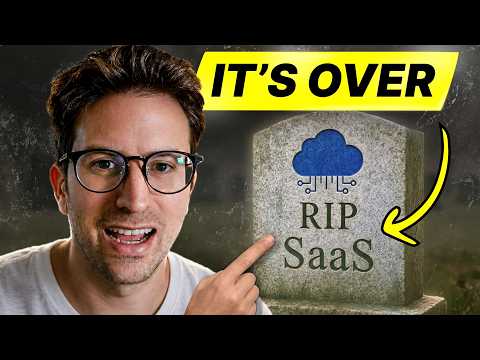

In this solo episode, I explain why I say SaaS is dead and what I see taking its place. For 15 years, SaaS meant paying engineers to build a tool and charging per seat, and now models like Opus 5.5, GPT-6, and Argon make the tool easy to build. I walk through what I call smart SaaS: give the tool away for free, collect data and network effects, and make money by upselling AI agents and human services. I share a calorie tracking example, three ways to charge, and why enterprises still pay per seat. If you build software, this episode gives you a map for building something people want in a market where the tool is free.
Timestamps
00:00 – Intro
00:47 – SaaS 1.0
02:56 – SaaS 2.0: The New Business Model
05:12 – How to monetize SaaS 2.0
06:18 – Service is the new Software
07:22 – SaaS Is Dead, Long Live SaaS
08:58 – SMB vs Enterprise
10:31 – Closing Thoughts
Key Points
• AI makes the tool easy to build, so the per-seat model of the last 15 years has run its course.
• Smart SaaS gives the tool away and collects data and network effects as payment.
• The money comes from upselling intelligence from AI agents and services from humans.
• Agents can charge by token or by outcome, and human services by the week or month.
• SaaS for SMBs, prosumers, and individuals trends toward free, while enterprises still pay something per seat.
• The market for getting things done is bigger than the market for tools, so the total market for SaaS grows.
Numbered Section Summaries
1. How SaaS Worked
For the last 15 years, the hard part of SaaS was getting enough smart engineers in a room to code a high-quality tool for a human to use. Customers paid per seat, at prices like $9.99 or $29.99, to use that tool in the cloud. The model made people billions of dollars, and Slack, which I believe sold for $29 billion, shows how well it worked.
2. AI Makes the Tool Easy
Models at the level of Opus 5.5, GPT-6, Astra, Argon, and Carbon make building the software easy. One or two people with AI can now build what used to take a team of 20, so charging per seat for a tool stops working.
3. Give the Tool Away
In smart SaaS, I still build a tool, and I give it away for free: the CRM, the dashboard, the app. I look for niches where people pay for a tool in the old model and hand them that tool at zero cost. Users pay with data, which I can sell or use to make the tool better, and with network effects that build a moat.
4. Upselling Intelligence
I call the old model dumb SaaS because it is only a tool, and the new model smart SaaS because it is intelligent. With a free CRM, I charge when the customer wants AI agents to do work in it, or I upsell a service delivered by humans, which lines up with Sequoia’s view of trillion-dollar services as the new software. A calorie tracking app can give away the tracker, charge for agents that build personalized meal plans or track calories more precisely, and sell a weekly weight coach.
5. A Product Studio of Free Tools
Per-seat pricing limited the market, since only some people want to pay for tools. I see a product studio built around free tools, with upsells to agents or humans, as a way into the many niches that are wide open right now. That is why I say SaaS is dead, long live SaaS.
6. Pricing Agents and Services
Agents can charge by token or by outcome, so the customer pays when the agents complete the work. Human services can charge a weekly or monthly fee. The market for people accomplishing things is bigger than the market for people using a tool, so I see the total market for SaaS growing.
7. Where Enterprises Fit
SaaS for SMBs, prosumers, and individuals trends toward free. Fortune 500 and Fortune 2000 companies may still pay something per seat, a number I expect to drop over time, plus upsells to humans and superintelligence. Some enterprises want to pay for the security and for the feeling of being taken care of.
The #1 tool to find startup ideas/trends – https://www.ideabrowser.com
LCA helps Fortune 500s and fast-growing startups build their future – from Warner Music to Fortnite to Dropbox. We turn ‘what if’ into reality with AI, apps, and next-gen products https://latecheckout.agency/
FIND ME ON SOCIAL
X/Twitter: https://twitter.com/gregisenberg
Instagram: https://instagram.com/gregisenberg/
LinkedIn: https://www.linkedin.com/in/gisenberg/
