


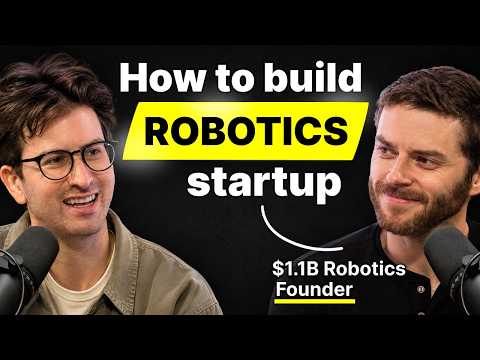

I sit down with Adrien Gaidon, Co-founder and Chief Strategy Officer of Walden Robotics, to map out where the openings sit in robotics and physical AI. Adrien explains how teams now teach robots with data, why deployment data carries the most value, and why Walden picked wheels and two-finger grippers for factory work. We dig into the opportunities around the big labs: data with scarce access, supply chain, teleoperation, insurance, software tools, and niche robots. If robotics feels like a game for companies with $300 million seed rounds, this episode lays out the smaller ways in too.
This episode was made possible thanks to Anthropic (the team behind Claude) for hosting us at Claude Founder house and sponsoring the episode.
Timestamps:
00:00 – Intro
01:48 – The current Robotics Landscape
03:01 – The Data Opportunity
11:17 – Robots on Team Human
13:24 – Inside Walden’s Factory Robots
19:40 – Where to Start a Robotics Company
30:02 – How Physical AI Works
32:02 – Picking Your Level of Hard
36:31 – Advice for breaking into Physical AI
38:32 – Overhyped in Physical AI
41:02 – Optimal Design for Robots
42:20 – Favorite Robots
45:44 – Robots for the Home
48:57 – Wrap
Key Points
• Deployment data carries the most value, and teams earn it by putting robots on production floors.
• A strong data business sits where scarce access meets data that is useful for robots.
• Data, compute, and manufacturing are linked bottlenecks that a robotics company widens together.
• Robots that learn from deployment gain value over time, which opens new ways to price and sell them.
• Bundling many small tasks makes automation pay where each task alone falls short.
• Founders can pick their level of hard, from general-purpose robots to one-task niches like welding or gardening.
Numbered Section Summaries
1. From Programming to Teaching
Factory robots used to follow programmed points in space, blind to anything in their path. Adrien explains that teams now teach robots with data: web, video, and language data build a common-sense foundation model, and task demonstrations build the skill. He says he felt the physical version of AGI back in 2022, when his co-founders built diffusion policy and showed a robot could learn a task from examples.
2. The Data Opportunity
Buying data can speed a team up, but Walden values deployment data most, and companies earn that by working with manufacturers like Toyota. For anyone starting a data business, Adrien points to privileged access, such as a family business, friends, or deep knowledge of a hobby like coffee, combined with data that helps robots on tasks they still struggle with. He extends the Venn diagram with Ikigai, the Japanese idea of finding what you love, what the world needs, and what it pays for.
3. Robots on Team Human
Adrien calls his team "roboticists on Team Human" and names WALL-E and Johnny Five as the models. Walden gives its robot an asymmetric head so it looks curious, and tunes its motion to feel friendly. The company name comes from Thoreau’s Walden and its values of self-reliance, simplicity, and purpose. In 10 years, Adrien expects millions of robots, a manufacturing boom, cheaper infrastructure projects, and people who build like Iron Man.
4. Robots That Gain Value Over Time
Older robots sold as CapEx and repeated the same motion for years. Robots that learn deliver a service, and customers who teach them more get more ROI, which Adrien ties to Jensen Huang’s line "the more you buy, the more you save." I point out the shift from per-seat and hardware pricing toward pay per outcome and per token, and Adrien encourages founders to rethink how their customers want to buy.
5. Where Founders Can Start
Adrien lists open areas: data, supply chain for high-mix and high-volume production, jobs at robotics companies across sales and design, teleoperation for slower robots, and insurance for robots and vibe-manufactured products. Software founders can sell shovels, as Weights & Biases did, and Adrien’s team was its first customer ahead of OpenAI. He suggests founders start with Russ’s lectures on YouTube, then look for an edge in a niche like welding, a barista robot, or gardening.
The #1 tool to find startup ideas/trends – https://www.ideabrowser.com
LCA helps Fortune 500s and fast-growing startups build their future – from Warner Music to Fortnite to Dropbox. We turn ‘what if’ into reality with AI, apps, and next-gen products https://latecheckout.agency/
FIND ME ON SOCIAL
X/Twitter: https://twitter.com/gregisenberg
Instagram: https://instagram.com/gregisenberg/
LinkedIn: https://www.linkedin.com/in/gisenberg/
FIND ADRIEN ON SOCIAL
Walden Robotics: https://www.waldenrobotics.com
X/Twitter: https://x.com/adnothing
LinkedIn: https://www.linkedin.com/in/adrien-gaidon-63ab2358/
