


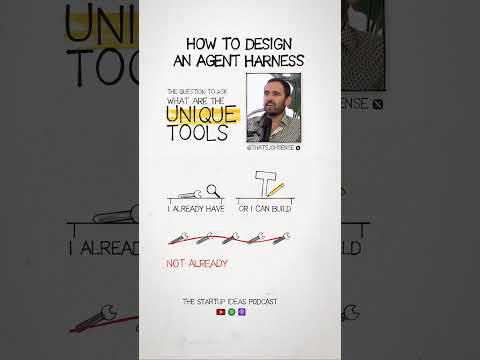

I sit down with Jon Noronha, co-founder and chief product officer of Gamma, to break down agent harnesses and the startup openings around them. Jon explains how Gamma rebuilt its product as a creative agent this year and walks me through the roughly 20 models and 200 calls behind one finished presentation. We talk about AI smell, why taste carries more weight than evals in creative work, how Gamma tests a new model within the hour, and the fast mode test that lost to good friction. Jon also shares the harnesses he wants to see, from a Slack agent that learns his voice to a couch shopping tool that checks the fit in your room. If you want to build a vertical agent, this episode gives you a clear model of what a harness is and where your edge can come from.
This episode was made possible thanks to Anthropic (the team behind Claude) for hosting us at Claude Founder house and sponsoring the episode.
Numbered Section Summaries
1. What is an Agent Harness
Gamma started in 2020, took off in 2023, and spent this year rebuilding its product from preset LLM workflows into an agent. Jon defines the harness as the tools an agent uses to act in its environment, inspect its own work, and ask the user for preferences, with Claude Code as the best-known example for programming. I call harnesses the new wrappers, and Jon agrees, since the wrapping is most of the work and even OpenAI and Anthropic put heavy effort into harness development.
2. Inside One Gamma Prompt
When someone pastes messy notes and asks for 20 slides, Gamma spins up a cloud sandbox, asks a few questions through a form, and pulls context from Notion, Slack, or Linear. It writes an outline, picks a template with vision models and embedding search, then generates text, layouts, images, and charts in parallel in about a minute. A vision model checks every slide for misaligned text, cropped heads, and weak contrast, and after rounds of fixes the deck has used about 20 models and 200 calls.
3. Where Vertical Harnesses Fit
Jon looks for problems that differ from coding: subjective work where people disagree on what good looks like and care about the specifics of the output. He likes personal video games for non-technical players and sees physical services, legal tech, and medical tech as active areas, though I’d pass on legal tech today because it feels crowded. Jon names three kinds of edge: a distinct vision you move toward faster, proprietary data, and businesses that mix AI with hardware or real-life services.
4. Image Models, Niches, and Loving the Work
Jon calls AI image models underhyped, since most people use them for menus and logos while Gamma uses about 10 image models for diagrams, textures, and icons. A couch shopping harness could render a couch in your room, measure it in pixels to tell a 58-inch from a 68-inch fit, and suggest a better option, with interior designers and pros at companies like Restoration Hardware as durable buyers. Jon closes with advice to pick work you could dogfood eight hours a day, and I add my rule to marry the niche and date the product.
FIND ME ON SOCIAL
X/Twitter: https://twitter.com/gregisenberg
Instagram: https://instagram.com/gregisenberg/
LinkedIn: https://www.linkedin.com/in/gisenberg/
FIND JON ON SOCIAL
X/Twitter: https://x.com/thatsjonsense?lang=en
LinkedIn: https://www.linkedin.com/in/jonnoronha/
